Sub-Zero Ice Maker Repair
Sub-Zero Ice Quality in Dover: Supply, Fill Valve or Harvest
Poor Sub-Zero ice almost always starts upstream of the machine: fill volume, a lapsed filter cartridge, or a mould that never gets cold enough. Read the cube first, follow the water second, and leave the harvest side to a meter.
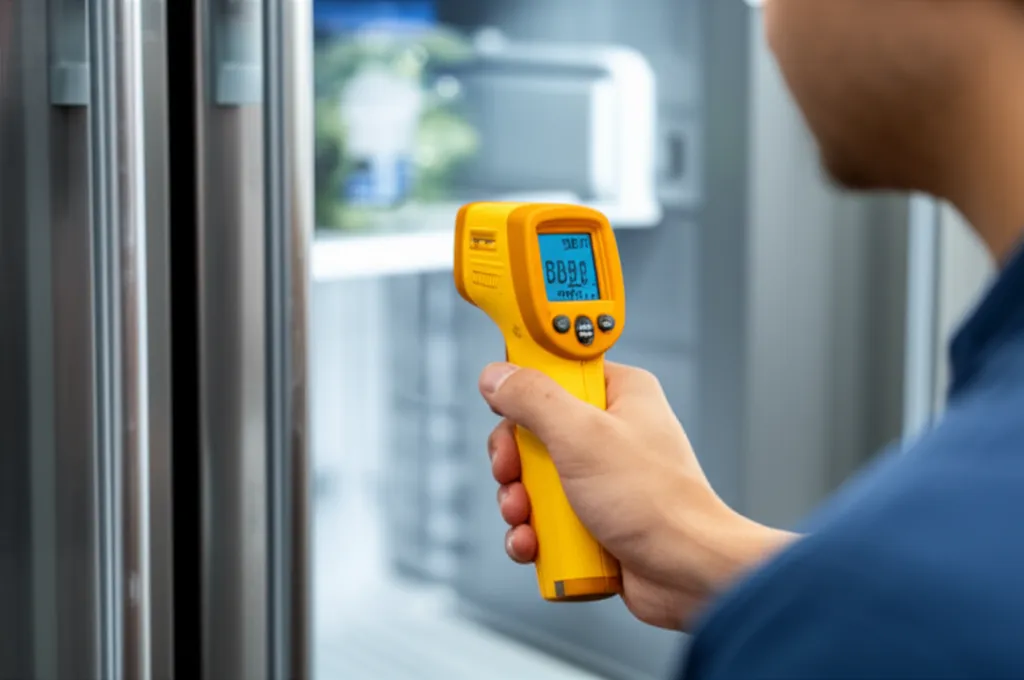
Nobody calls about ice on the day it stops. They call about six weeks after the cubes started coming out small, and by then the household has stopped noticing. That gradual version — output that thinned rather than failed — is the hardest one to describe over the phone and the easiest one to diagnose properly, because the evidence is sitting in the bin.
Shape, clarity, size: three separate signals
A cube carries most of the diagnosis on its surface. Dished or hollow cubes say less water reached the mould than the cycle expected. Cloudiness is dissolved air and minerals leaving solution as the water freezes. A solid slab means loose cubes bonded together after they were made. Small but otherwise well-formed cubes are a fourth, separate reading.
Those four do not point the same way, which is why “the ice has gone bad” is a useless starting description. Tip a scoopful onto a dry towel and look at the cubes one at a time instead of as a mass.
Dover helps here in a way most towns do not. Kitchens out on the long driveways are large, and a great many houses carry a second unit in a pantry or a mudroom off the back. Two machines fed from the same house supply hand you a free comparison. If the pantry unit still drops clear, full cubes while the kitchen unit does not, the water arriving at the house is not your variable. If both have thinned across the same few months, work upstream before you open either one.
The water side, checked before the machine
Follow the water before suspecting the appliance. Three faults account for most slow declines: a stop valve left partly closed after plumbing work somewhere in the house, an old saddle fitting whose needle has crept shut, and a feed line crushed where a cabinet was pushed back into place. Each one reduces fill volume, and reduced fill volume is what a hollow cube looks like.
The fill valve only opens for a few seconds per cycle. A stop that is open but not fully open will still deliver a strong stream at the kitchen tap while starving a valve working in short bursts — which is exactly why the tap is a poor witness. In an older Dover farmhouse the shut-off is usually somewhere in a basement, closed by whoever last replaced a water heater and never fully reopened.
Crushed lines are a renovation artefact. When a built-in gets pushed back after floor work, the soft copper or plastic behind it is the first thing to give.
The filter, and the interval that lapsed
A loaded cartridge restricts flow long before it changes the taste, so waiting for the water to taste wrong means waiting for the wrong signal entirely. This is the single most common reason ice quality slides across a season in a house where nothing else changed.
Aftermarket cartridges raise a second question, which is flow rate rather than filtration. A cartridge can be perfectly clean and still pass less water per second than the machine was designed around, and a fill valve that opens for a fixed interval simply gets less.
Many units accept a bypass in place of the cartridge. If cubes recover to full size with the bypass fitted, that cartridge was a genuine restriction. It does not clear the rest of the supply — it proves one restriction was real, nothing more. Replacement intervals are not the same across the range, which is why the figure worth trusting comes from your own series’ use and care guide rather than from any general rule.
The appliance is not cold enough to make good ice
Ice quality depends on the temperature at the mould, which is not the number on the display. The control reports the compartment as a whole; the maker occupies one corner of it. A compartment packed to the walls, or a vent buried behind a stack of boxes, can leave that corner warmer than the set point suggests.
Freeze time is the mechanism. Slow the freeze and cubes come out smaller and less clear, because the water has more opportunity to give up what is dissolved in it before it locks. Nothing has broken; the machine is simply working in worse conditions than it was designed around.
Door habits belong in this honestly. Production rates are quoted per twenty-four hours and assume the door spends most of them shut. A house full of guests, a mudroom unit whose surroundings swing with the weather, or a compartment reloaded warm after a shop — all of them cost recovery time, and recovery time is freeze time.
Cubes that form and never leave the mould
Harvest is the release half of the cycle. Water fills the mould, the cubes freeze, the mould is then warmed just enough for the ice to let go, and an ejector sweeps it into the bin. Making ice and releasing it are separate jobs and they fail separately.
A slab in the bin usually indicates cubes that dropped normally and then bonded, which points at harvest timing or at low turnover rather than at freeze capacity. In a Medfield house where the bin sees nothing between weekends, that is demand behaviour rather than a fault.
You can watch two things without tools. The sensing arm rises and falls to stop production when the bin fills; if a bag of ice or a tray is holding it up, production simply stops with no code and no noise. And the ejector should sweep clear. What you should not do is chip at a full mould with anything metal or take the module apart — that is where the Sub-Zero Ice Maker Repair page picks it up.
The point where this needs a meter, not another guess
Water on the floor, a damp line behind the cabinet, a compartment that will no longer hold its temperature: any one of those is where guessing has to stop. Those three change the priority, because a leak inside a cabinet run does damage quietly and a compartment losing temperature is no longer an ice problem.
Three measurements settle nearly all of these and none can be made by eye: fill volume per cycle, inlet pressure at the valve while it is actually open, and the timing of the cycle itself. A diagnostic visit runs $95, and repairs in this family — the maker, the water valve or the supply line — usually land between $280 and $720 depending on which of the three it turns out to be. Sherborn, Medfield and Dover are all worked from here. There are two ways to reach us and both sit at the top of this page: the telephone number and the booking link.
Asked on the phone
- What changed if the cubes have started fusing into one lump?
- Fusing usually happens after the cubes are made rather than while they are made, so freeze capacity is rarely the problem. Either the harvest is releasing batches faster than the bin clears them, or nobody is using the ice and the surface of each cube is slowly bonding to its neighbours. Empty the bin completely, then check what a week of normal use looks like from a clean start.
- Why would output fall away over the summer specifically?
- Warmer months change two things at once. Demand rises, so the bin is emptied more often and the machine is asked to run closer to its ceiling. At the same time the door is opened far more, which costs recovery time, and recovery time is freeze time. A machine that keeps up all winter can look weak in July without a single component having failed.
- The tap water is perfectly clear, so why is the ice cloudy?
- Clarity in a glass and clarity in a cube are different tests. Water holds dissolved air and minerals invisibly at room temperature, and freezing forces them out of solution — they collect in the middle of the cube as the outside locks first. A slow freeze gives them more time to gather, which is why cloudiness often arrives alongside cubes that are also smaller than they used to be.