The brand · Sub-Zero
Sub-Zero built-ins, and how they tell you what is wrong
Sub-Zero refrigeration fails in a small number of recognisable ways, and most of them can be narrowed to one or two candidates from the symptom alone — before a grille comes off, and often before anyone gets in the van.
Flat $95 service call · line answered 24/7
Two systems
Dual refrigeration is the first thing a symptom tells you
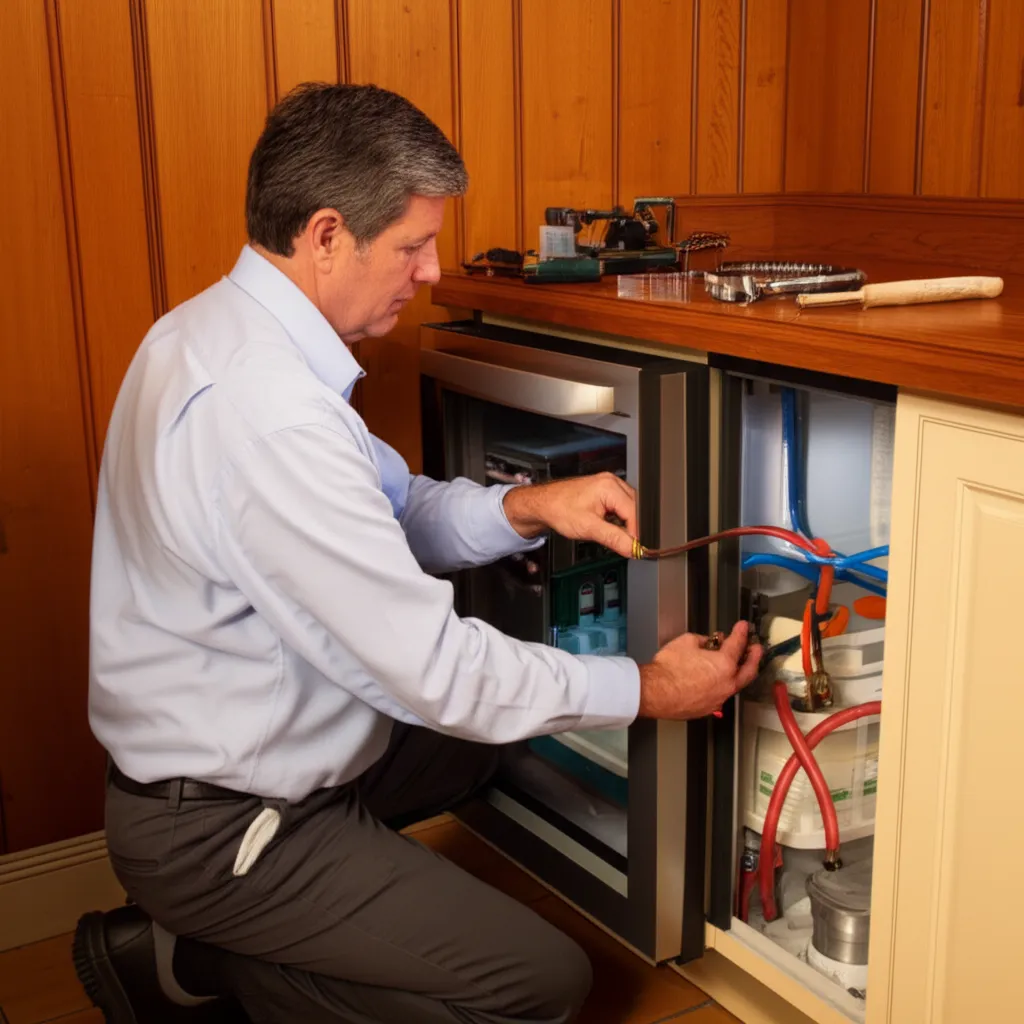
The classic built-in runs two sealed systems in one cabinet: a separate compressor and evaporator for the fresh food side and another for the freezer, deliberately kept apart so that dry freezer air never reaches the food. That design hands you a free diagnostic. A fresh-food compartment drifting into the fifties while the freezer is still rock hard is a fresh-food circuit fault, and the freezer compressor — the one people assume is the expensive problem — is provably fine.
Read it the other way and the same logic holds: soft ice cream with a cold refrigerator points at the freezer circuit, its evaporator fan or its defrost. Both compartments warm at once is the case that deserves suspicion, because two independent systems rarely fail on the same weekend. That pattern usually means something they share — supply, the control, or a condenser so blocked that neither side can reject heat.
Not every unit is built that way. Undercounter refrigeration, drawer units and some integrated models run a single system and move air between compartments, so on those the split does not exist and airflow is the first thing to rule out rather than the last.
Airflow
The condenser, the grille, and the dust that decides everything
More calls come down to a matted condenser than to any component failure. Depending on the platform the coil sits behind the grille at the top of the cabinet or low at the base, and either way it is pulling room air through fins spaced closely enough to trap everything in it. As the mat builds, head pressure rises, run times stretch, and the compartment that loses the argument first is fresh food.
This is the one job worth doing yourself. Kill the power, take the grille off, and use a vacuum with a brush head and a soft brush to clear the fins in the direction they run — not across them, which folds them over and makes the problem permanent. Houses on gravel drives or with shedding dogs need it far more often than the manual suggests. If the unit carries an air filter, its life is measured in months rather than years.
Before you decide it is broken
- Check the grille and the coil behind it, and whether anything has been stored hard against the back or sides of the cabinet.
- Watch whether the compressor is cycling off at all, or simply running continuously.
- Feel the floor and the toe area near the grille — persistent warmth there goes with a coil that cannot shed heat.
Frost
Frost patterns read very like a fault code
Where the ice forms is more informative than how much of it there is. An even sheet across the back wall of the freezer, returning within days of being cleared, is a defrost circuit question: the heater, the terminator or sensor that governs it, or the board that is meant to call for it. Frost concentrated at the door frame or down one hinge side is warm room air getting in, which is a seal, a sagging hinge or a closer no longer pulling the last quarter inch.
Ice in the trough under the evaporator, or water tracking onto the floor overnight, is the drain — blocked or frozen at the outlet so meltwater from each defrost has nowhere to go. It is the cheapest fault on this page and one of the most common, and it is frequently mistaken for a leak.
One thing not to do: chipping at ice with a knife or a screwdriver. An evaporator tube punctured that way turns a defrost fault into a sealed-system repair, which is the most expensive job on the list.
Electronics
Boards and sensors, and why neither gets swapped on suspicion
Later units keep a fault history and will report what their sensors believe they are seeing. That is useful and it is not the whole truth: a thermistor drifting out of tolerance reads perfectly plausible and is wrong, and a board asked to act on a wrong number behaves exactly as designed. So the compartment temperatures get measured directly and compared with what the control thinks it has, and the loads get proven before the board is blamed.
A board is a genuine failure often enough to matter, and it is the one part that gets fitted only after the cheaper explanations have been eliminated in front of you. It is also worth knowing that a door refusing to reopen for a few seconds after being closed is not a fault at all — the cabinet has pulled a slight vacuum, and the gasket is doing its job.
Onward
By the appliance, and by the other name on the kitchen
The brand split by which unit has gone wrong — plus the two manufacturers people most often ring about by mistake, explained rather than taken.
-
Refrigerator repair
Built-in and integrated columns, side-by-sides and the older units still in service.
-
Freezer repair
Frost, defrost circuits, blocked drains and units that will not restart.
-
Ice maker repair
Fill and harvest faults, and the water behind most of them.
-
Wine storage repair
Dual-zone drift, condensation on the glass and fan noise.
-
Miele refrigeration
A different integration problem entirely, and not a call this shop takes.
-
Wolf ranges and ovens
Same parent manufacturer, different trade — clicking burners and weak igniters.
Reviews
On Sub-Zero built-ins around the four towns
5out of 5from 622 reviews
5 out of 5
The second unit in the back pantry had been creeping up for weeks and we blamed the door being opened too often. It was a seized evaporator fan motor. He showed me the shaft before fitting the new one, then vacuumed the whole coil area out before he left.
Peter M.Sherborn
5 out of 5
Ice cream was going soft although the panel still read zero, so I nearly ignored it. He measured real air temperature at the vent rather than trusting the display, found the defrost heater open, and swapped it. He also traced the stain that explained the smell.
Priya N.Medfield
5 out of 5
The whole bin had fused into one solid block. He traced it to a bin thermostat that had stopped calling for shutoff, and while he was in there he flushed the line that runs through the cold pantry wall.
Lorraine F.Dover
Talk to someone
Describe the symptom and the model number, and most of this narrows itself.
The flat $95 service call covers the trip and the full diagnosis, and comes off the total on an approved repair.